
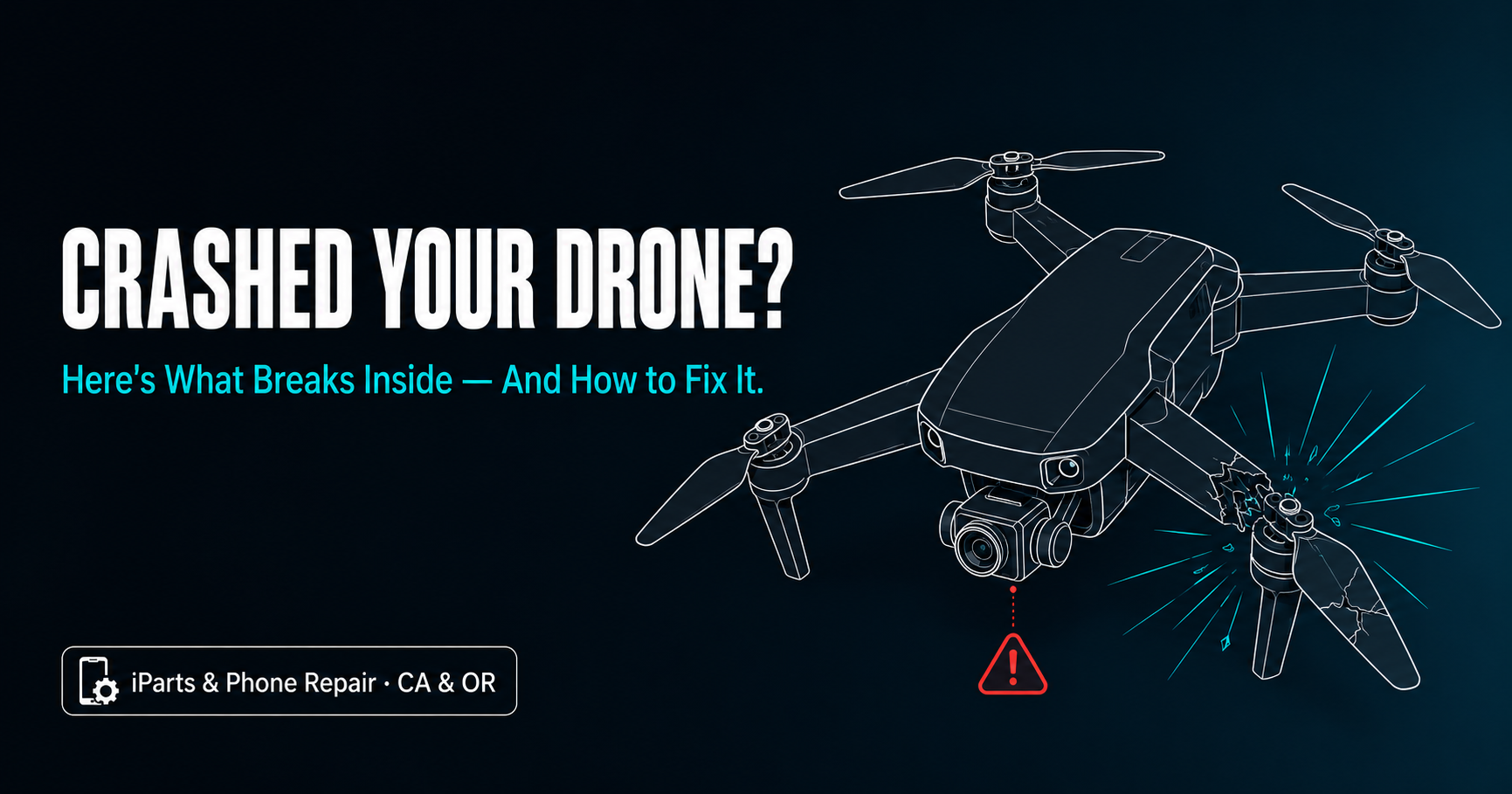
It happens in a split second. You’re flying over the Sacramento River, lining up a perfect shot, and then — a gust of wind, a lost signal, one wrong stick movement — and your drone is in freefall. Maybe it lands in a tree. Maybe it hits the pavement. Maybe it goes into the water. You pick it up and assess the damage: a bent arm, a snapped propeller, a camera that won’t swivel. And then the question every drone owner asks in that moment: is this fixable, or am I buying a new one?
Drone repair is more nuanced than most device repairs. A crashed drone isn’t just one broken thing — it’s potentially four or five systems that all took stress at the same time, and figuring out which ones are actually damaged versus which ones just look rough on the outside is what determines whether a repair makes sense. At iParts and Phone Repair, we’ve worked on drones from hobbyist flyers and real estate photographers to cinematographers and agricultural operators. Here’s what our technicians actually look at when a drone comes in after a crash.
Section 1: What a Crash Actually Does Inside Your Drone
Drones are complex machines. A single crash event puts stress on multiple systems simultaneously, and the visible damage — a cracked arm, a broken prop — is often the least of your problems.
The Motors
Brushless motors are the heart of a drone’s flight system. Each motor spins at thousands of RPM and is precisely balanced for stable flight. A crash can bend motor shafts, crack motor bells, damage internal bearings, or burn out motor windings if the impact caused a sudden stall while under full throttle. A motor that spins when you power up but wobbles or makes a grinding sound has almost certainly taken internal damage. Flying on a damaged motor accelerates wear on the others and can cause a secondary crash.
The Electronic Speed Controllers (ESCs)
ESCs regulate the power flow to each motor. They’re compact boards that live either inside the frame or embedded in the flight controller stack. Impact stress — especially on hard surface crashes — can crack solder joints on the ESC, pop capacitors, or physically fracture the board. A drone with an ESC fault will typically yaw uncontrollably or fail to arm at all, even if everything looks intact externally.
The Camera Gimbal
The camera gimbal is one of the most impact-sensitive components on any camera drone. It’s designed to absorb and correct for flight vibration — not for collision force. A crash can strip the small plastic gear mechanisms inside the gimbal, bend the motor mounts, or damage the ribbon cable that connects the camera to the flight controller. A gimbal that won’t level, drifts to one side, or produces shaky footage despite stable flight has almost always taken crash damage. Our drone repair service assesses gimbal function as a standard part of every post-crash diagnostic.
The Frame
Carbon fiber and plastic frames crack, split, and delaminate under impact. Carbon fiber damage is particularly deceptive — a frame can look clean on the surface while having internal fractures that compromise structural integrity. Flying a structurally compromised frame risks mid-air failure. Frame damage is usually the most visible repair need after a crash, but it’s rarely the only one.
The Battery
LiPo (lithium polymer) batteries used in most drones are extremely sensitive to physical impact. A crash can cause internal cell damage that isn’t visible externally but results in dramatically reduced flight time, thermal swelling during charge, or in serious cases — a fire risk. Any drone battery that puffed or swelled after a crash should not be recharged or used again. This is a safety issue, not just a performance one.
The Sensors and GPS Module
Modern drones rely on barometers, gyroscopes, accelerometers, and GPS for stable flight. Crash impact can knock sensors out of calibration or physically damage the GPS module. A drone that drifts uncontrollably in GPS mode, or that holds altitude poorly after a crash, may have sensor damage that doesn’t show up in a visual inspection at all.
Section 2: The Most Common Drone Repairs We See
After evaluating hundreds of crash cases, here are the repair types our technicians handle most frequently.
Motor Replacement
Single motor replacements are the most common drone repair request. A crashed motor is almost always worth replacing on a quality drone — motors are relatively inexpensive compared to the drone itself, and a single bad motor affects the entire flight system. We match replacement motors to the original specs to preserve performance balance across all four.
Propeller Replacement
Props are the most expendable component on a drone and the easiest to replace. If a crash only snapped props and the motors and frame are intact, you’re looking at the simplest and cheapest repair possible. We keep stock of common prop sizes and can have most drones ready to fly the same day on a prop-only repair.
Gimbal Repair and Calibration
Gimbal repairs range from cable replacement and gear repair to full gimbal assembly replacement. After repair, gimbal calibration is essential — a mechanically repaired gimbal that hasn’t been calibrated will still produce drifting or horizon-tilt footage. We calibrate after every gimbal service.
Water Damage Recovery
Water exposure is the most urgent drone repair situation. Salt water is especially aggressive — it corrodes circuit boards within hours. Water damage repair on drones follows the same principles as phone water damage: power the drone off immediately, do not attempt to charge it, and bring it in as quickly as possible. We disassemble, clean, and dry the internal electronics using professional methods. Recovery rate improves dramatically the sooner the drone reaches a technician.
ESC and Flight Controller Repair
Board-level repairs on ESCs and flight controllers require micro-soldering capability and familiarity with drone firmware. These are more involved repairs, but they’re often the difference between a $150 board repair and a $400+ replacement — especially on higher-end drones where the flight controller stack is a significant portion of the drone’s value.
Battery Assessment and Replacement
Any battery that shows swelling, reduced capacity, or voltage irregularity after a crash needs to be replaced. We test battery discharge curves and internal resistance to assess whether a post-crash battery is safe to continue using before recommending replacement.
Section 3: Should You Repair or Replace? Making the Smart Call
The repair-vs-replace decision on a drone comes down to three factors: the cost of repairs relative to the drone’s replacement value, the severity and spread of damage across systems, and whether the drone’s core components (flight controller, motors, ESC stack) are salvageable.
Repair almost always makes sense when: The frame and flight electronics are intact, damage is isolated to motors, props, gimbal, or battery, and the drone originally cost $300 or more. A DJI Mini or Mavic series drone with a crashed gimbal, broken prop, and a bent arm is an excellent repair candidate — the core value is the flight system and camera, which are intact.
Replace may make more sense when: The flight controller, ESC stack, and frame all took serious damage simultaneously, the drone originally cost under $150, or the repair estimate approaches 60–70% of the drone’s replacement cost. In those cases, we’ll tell you honestly rather than recommend repairs that don’t make economic sense.
Get a diagnostic first regardless. Visual inspection only tells part of the story. A drone that looks like it only needs props might have a bent motor shaft or an ESC with cracked solder joints that won’t show up until you attempt to fly again — at altitude. Our in-house diagnostic gives you the full picture before you commit to anything. You can get an instant quote online, or visit any of our California and Oregon locations for a walk-in assessment.
Not local? Our mail-in repair service handles drones from customers across the country. Drone repairs requiring special order parts typically arrive and ship back within a few days of receiving the device.
One additional note: if your drone uses an action camera like a GoPro that also took damage in the crash, our GoPro camera repair service handles that separately. Broken lenses, damaged charging ports, and water exposure are the most common GoPro repairs we see come in alongside drone cases.
Section 4: Conclusion and Final Thoughts
A crashed drone is a stressful moment — especially if you were mid-shoot or flying expensive equipment. But most crashes are survivable from a repair standpoint. Motors, props, gimbals, and even ESCs are replaceable components. The key is an accurate diagnostic before assuming the worst, and fast action in cases involving water exposure.
iParts and Phone Repair has been handling complex device repairs since 2014 — from iPhones to iPads, laptops to game consoles, and yes, drones. Our technicians approach drone repair with the same precision and accountability we bring to every device that comes through our doors. Walk in with your crash-damaged drone, tell us what happened, and we’ll tell you exactly what it needs. No guesswork, no inflated estimates.
FAQs
What drone brands do you repair? We repair DJI drones (including Mavic, Mini, Air, and Phantom series), as well as Autel, Parrot, Holy Stone, and other consumer and prosumer models. If you’re not sure whether we service your model, call ahead or bring it in.
Can a water-damaged drone be repaired? Often yes, if it’s brought in quickly. The key is powering the drone off immediately after water contact and not attempting to charge or fly it. The longer the internal components stay wet or are exposed to ionic residue, the more corrosion spreads. Same-day evaluation gives the best recovery odds.
Is it worth repairing a crashed drone? It depends on which components were damaged and the drone’s original value. Isolated damage (motors, props, gimbal, battery) on a drone worth $300 or more is almost always worth repairing. We’ll give you an honest cost assessment and let you make the call.
How long does drone repair take? Simple repairs like propeller and motor replacement can be done the same day. Gimbal repairs, board-level work, and water damage recovery typically take 1–3 days depending on part availability. If parts need to be ordered, we’ll give you an estimated timeline upfront.
Can I repair my drone myself? Simple prop replacements are straightforward. Beyond that, drone repair requires knowledge of brushless motor specs, ESC firmware, gimbal calibration software, and soldering skills for board-level work. Incorrect repairs — particularly wrong-spec motors or improper gimbal calibration — can cause additional crashes.
Do you also repair GoPro cameras that were mounted on the drone? Yes. GoPro repairs are handled through our dedicated GoPro camera repair service. Broken lens, damaged charging port, and water damage are the most common repairs. Bring both the drone and the camera in together for a combined diagnostic.
Disclaimer
This article is for informational purposes based on general drone repair experience and is not a substitute for a professional diagnostic of your specific device. Damaged LiPo batteries can pose a fire or safety risk — do not charge, puncture, or store a damaged drone battery indoors without professional evaluation. FAA regulations regarding drone registration and operation apply regardless of repair status; consult FAA.gov for current rules on drone use in your area. iParts and Phone Repair makes no guarantee of repair outcomes without first inspecting the affected device.